Redefining Authority in Online Slot Game Reviews: Industry Insights and Consumer Guidance

Over recent years, the landscape of online gambling has evolved dramatically, driven by technological innovation, regulatory shifts, and an increasingly discerning consumer base. At the heart of this transformation lies the critical importance of credible, in-depth game reviews—especially those that bridge the gap between entertainment and responsible gambling. In this context, the role of authoritative review sources has become paramount, not merely for players seeking entertainment but also for industry professionals aiming to uphold standards and transparency.

The Evolution of Slot Game Reviews: From Bet Listings to Expert Analysis

Historically, online slot reviews often consisted of basic descriptions and static payout tables. However, as the industry matured, so too did the complexity and expectations surrounding reviews. Gone are the days when superficial analyses sufficed; today’s players demand a nuanced understanding of game mechanics, RTP (Return to Player) percentages, variance, bonus features, and the underlying software providers.

Moreover, with the proliferation of titles—from classic fruit machines to visually stunning, feature-rich slots—the importance of expert evaluation has grown. Industry insights now play a pivotal role in guiding not only casual players but also seasoned gamblers seeking strategic advantages or responsible gaming tools.

Establishing Credibility: The Value of Expert Content in Gaming Publications

Credibility in gambling content hinges on transparency, data accuracy, and comprehensive understanding. Leading industry publications embed deep knowledge of game design, player behaviour, and regulatory frameworks to deliver authoritative content. These platforms often collaborate with game developers, data analysts, and responsible gambling advocates to present balanced reviews.

For example, authoritative sources incorporate detailed metrics such as:

  • RTP documentation: ensuring players understand potential returns.
  • Volatility profiles: informing risk appetite.
  • Special features analysis: such as free spins, jackpots, bonus rounds.
  • Security and fairness assurances: like licensing information and RNG certification.

Why Industry Leaders Rely on Expert Reviews for Consumer Confidence

Consumers increasingly seek trusted recommendations to navigate the vast array of online slots. Industry stakeholders understand that well-articulated, evidence-based reviews foster transparency, bolster regulatory compliance, and elevate the industry’s reputation.

Here, the significance of established review portals is clear. They serve as benchmarks for quality and fairness, ensuring players can make informed decisions. Such portals often incorporate user feedback and machine-generated analytics, thus balancing subjective opinions with empirical data.

Embedding Authoritative References: The Case of The Eye of Horus review

An exemplary illustration of credible content within this ecosystem is exemplified by dedicated slot reviews such as The Eye of Horus review. This review exemplifies the rigour that modern consumers and professionals alike value—detailing game mechanics, RTP accuracy, and the fairness assurances guaranteed by licensed providers.

“An in-depth analysis like The Eye of Horus review not only informs players about game features but also contextualises its performance within broader industry standards, underscoring transparency and fairness.”

The Industry’s Shift Towards Transparency and Responsible Gaming

As the industry emphasizes player protection and integrity, reviews serve as educational tools that promote responsible gaming habits. Reliable sources provide insights into RTP percentages, house edges, and optional limits on deposits or playtime, fostering sustainable engagement.

The presence of detailed, credible reviews eases player decision-making and encourages trust in licensed operators. This aligns with regulatory directions, such as those imposed by the UK Gambling Commission, which mandates transparency and fairness.

Conclusion: The Future of Online Slot Reviews and Industry Standards

The ongoing digital revolution necessitates that industry leaders and content creators uphold rigorous standards in sharing game analytics and reviews. The integration of verified data, expert insights, and credible references like The Eye of Horus review embodies this evolution—transforming reviews from mere promotional material into vital tools for informed gambling.

Ultimately, the game review landscape must continue to evolve, blending technological advancements with ethical transparency, to serve both consumers and industry stakeholders effectively.

For those keen on exploring detailed, expert evaluations of popular online slots, comprehensive reviews like The Eye of Horus review provide invaluable insights rooted in industry standards and fair gaming principles. Such content is essential in fostering a safer, more transparent online gambling environment.

The Evolution and Significance of Ancient Egyptian-Themed Slot Games

In recent years, online casino gaming has seen a remarkable transformation rooted in both technological innovation and cultural storytelling. Among the myriad themes that have captivated players worldwide, ancient Egyptian motifs stand out for their mystique, history, and enduring popularity. This article explores the complex landscape of Egyptian-themed slot games, emphasizing their origins, cultural significance, and evolving design that has made them a mainstay in digital gambling entertainment.

Historical Roots and Cultural Significance

Egyptian mythology and iconography have long fascinated the Western imagination, influencing art, literature, and popular culture. The allure lies in the civilization’s mysticism, grand monuments like the pyramids and Sphinx, and its ancient deities. As the gaming industry developed, developers sought to channel this fascination into engaging, thematic experiences.

The earliest incarnations of Egyptian-themed slots drew inspiration from archeological discoveries and classic Hollywood portrayals, which often romanticised the mythos. Over time, more sophisticated narratives and visual elements have been integrated, transforming these games into immersive journeys through a mystic land of treasures and deities.

The Design and Mechanics of Egyptian Slot Games

Modern Egyptian-themed slots typically employ high-quality visuals depicting temple courtyards, scarabs, hieroglyphs, and iconic symbols such as Anubis, Ra, and Cleopatra. The mechanics often include bonus rounds, free spins, and expanding wilds to evoke a sense of discovery and reward, aligning with the mythological symbolism of prosperity and protection.

Example: Many leading developers, like Microgaming and Play’n GO, incorporate layered storytelling and cultural elements that improve player engagement and retention. The intricacy of these designs reflects advances in animation and AI-driven game logic, enhancing user experience.
Feature Description Industry Impact
Visual Authenticity Rich hieroglyphics, temples, and artefacts recreated with high fidelity Enriches immersion, boosts player confidence
Bonus Features Free spins, treasure hunts, expanding symbols inspired by Egyptian myth Increases session length and profitability
Narrative Depth Storylines involving gods, pharaohs, and ancient mysteries Fosters emotional engagement and replay value

Industry Trends and Innovations

With the advent of mobile gaming and HTML5, Egyptian-themed slots have become accessible across devices, maintaining high resolution and interactive features. Developers are now exploring augmented reality (AR) and virtual reality (VR) integrations, aiming to transport players into immersive virtual temples.

Furthermore, the cultural sensitivity surrounding these themes has led to more authentic representations, with some companies consulting Egyptologists to refine their content. The goal is to balance entertainment with educational elements, enriching the player’s experience.

Connecting Cultural Heritage with Gaming Realities

“It is essential for game developers to recognise the cultural significance of the themes they portray, ensuring respectful and accurate representations while providing engaging gameplay.” – Dr. Emily Carter, Cultural Historian

In this context, the Internet offers invaluable resources and detailed information for players eager to deepen their knowledge of Egyptian mythology. For a thorough exploration of how these themes are crafted and the symbolism behind their elements, one can consult Eye of Horus: information. This site provides credible insights into Egyptian symbolism, game design inspirations, and industry perspectives, making it a trusted resource for both gamers and developers alike.

Conclusion: The Future of Egyptian-Themed Slot Gaming

The trajectory of Egyptian-themed slot games illustrates an ongoing dialogue between cultural homage and technological innovation. As developers embrace new immersive platforms, these themes are poised to captivate future generations of players, blending history, mythology, and cutting-edge gaming into compelling entertainment experiences.

To explore further, especially on the depth of Egyptian symbolism and its integration into gaming narratives, visit the comprehensive Eye of Horus: information. This resource exemplifies how credible, culturally sensitive content enhances the authenticity and appeal of thematic casino games, elevating them beyond mere entertainment into a celebration of ancient history.

The Evolution and Significance of Ancient Egyptian-Themed Slot Games

In recent years, online casino gaming has seen a remarkable transformation rooted in both technological innovation and cultural storytelling. Among the myriad themes that have captivated players worldwide, ancient Egyptian motifs stand out for their mystique, history, and enduring popularity. This article explores the complex landscape of Egyptian-themed slot games, emphasizing their origins, cultural significance, and evolving design that has made them a mainstay in digital gambling entertainment.

Historical Roots and Cultural Significance

Egyptian mythology and iconography have long fascinated the Western imagination, influencing art, literature, and popular culture. The allure lies in the civilization’s mysticism, grand monuments like the pyramids and Sphinx, and its ancient deities. As the gaming industry developed, developers sought to channel this fascination into engaging, thematic experiences.

The earliest incarnations of Egyptian-themed slots drew inspiration from archeological discoveries and classic Hollywood portrayals, which often romanticised the mythos. Over time, more sophisticated narratives and visual elements have been integrated, transforming these games into immersive journeys through a mystic land of treasures and deities.

The Design and Mechanics of Egyptian Slot Games

Modern Egyptian-themed slots typically employ high-quality visuals depicting temple courtyards, scarabs, hieroglyphs, and iconic symbols such as Anubis, Ra, and Cleopatra. The mechanics often include bonus rounds, free spins, and expanding wilds to evoke a sense of discovery and reward, aligning with the mythological symbolism of prosperity and protection.

Example: Many leading developers, like Microgaming and Play’n GO, incorporate layered storytelling and cultural elements that improve player engagement and retention. The intricacy of these designs reflects advances in animation and AI-driven game logic, enhancing user experience.
Feature Description Industry Impact
Visual Authenticity Rich hieroglyphics, temples, and artefacts recreated with high fidelity Enriches immersion, boosts player confidence
Bonus Features Free spins, treasure hunts, expanding symbols inspired by Egyptian myth Increases session length and profitability
Narrative Depth Storylines involving gods, pharaohs, and ancient mysteries Fosters emotional engagement and replay value

Industry Trends and Innovations

With the advent of mobile gaming and HTML5, Egyptian-themed slots have become accessible across devices, maintaining high resolution and interactive features. Developers are now exploring augmented reality (AR) and virtual reality (VR) integrations, aiming to transport players into immersive virtual temples.

Furthermore, the cultural sensitivity surrounding these themes has led to more authentic representations, with some companies consulting Egyptologists to refine their content. The goal is to balance entertainment with educational elements, enriching the player’s experience.

Connecting Cultural Heritage with Gaming Realities

“It is essential for game developers to recognise the cultural significance of the themes they portray, ensuring respectful and accurate representations while providing engaging gameplay.” – Dr. Emily Carter, Cultural Historian

In this context, the Internet offers invaluable resources and detailed information for players eager to deepen their knowledge of Egyptian mythology. For a thorough exploration of how these themes are crafted and the symbolism behind their elements, one can consult Eye of Horus: information. This site provides credible insights into Egyptian symbolism, game design inspirations, and industry perspectives, making it a trusted resource for both gamers and developers alike.

Conclusion: The Future of Egyptian-Themed Slot Gaming

The trajectory of Egyptian-themed slot games illustrates an ongoing dialogue between cultural homage and technological innovation. As developers embrace new immersive platforms, these themes are poised to captivate future generations of players, blending history, mythology, and cutting-edge gaming into compelling entertainment experiences.

To explore further, especially on the depth of Egyptian symbolism and its integration into gaming narratives, visit the comprehensive Eye of Horus: information. This resource exemplifies how credible, culturally sensitive content enhances the authenticity and appeal of thematic casino games, elevating them beyond mere entertainment into a celebration of ancient history.

Why stuff looks funny on Netflix

Recently the interwebs have been ablaze with outrage over the format of some videos seen on Netflix.  The site What Netflix Does kicked it off.  Kudos to the person behind for taking the time to make the site.  Many seemed to think that Netflix was manipulating the video for some unknown reason.

While the idea of a secret conspiracy is appealing, there’s nothing secret going on here.  As someone who’s spent a career in media companies and helped with the process of getting content to distribution partners, I can explain exactly what’s going on.
 
Here’s how the Internet thinks things work:
 
Media Company Staff #1:  The people in affiliate sales cut another deal with Netflix to show more of our stuff.
 
Media Company Staff #2:  Awesome.  Let’s make sure we provide the absolute best quality versions possible. Cost is no object! Those viewers at home deserve only the absolute best!
 
Media Company Staff #1:  I agree.  Let’s spend a lot of time and money getting this right.
 
How things actually work:
 
Media Company Staff #1:  The people in affiliate sales cut another deal with Netflix to show more of our stuff.
 
Media Company Staff #2:  Dammit! We are already overloaded with other deals and are understaffed. What do we have ready to go that doesn’t cost anything?
 
Media Company Staff #1:  Well, I think we have an up-scaled PAL version with pan & scan?  The audio is just stereo, but it’s ready to go.  Don’t cost nuthin’.
 
Media Company Staff #2: Not even HD? Well, the viewers won’t notice and we’re too busy to give a shit.  Ship it.
 
Yes, I know it sounds bad, but it’s very close to the truth.
 
The world of TV and film technology is full of subtle variations in aspect ratio, frame rate, color space, edits, and many other geeky ways.  To suit all the various traditional distributors of TV and film, studios end up with multiple versions.
 
Everyone has a different point of view on how best to display 2.35 or 1.78 ratio films on a 16×9 television screen.  Don’t forget that for YEARS studios made cropped ‘Full Screen’ versions of wide screen films on DVD because many consumers hated letter box versions.  Not everyone is an aspect ration perfectionist.  In addition to aspect ratios, there are different video edits, text languages, and caption & subtitle tracks to boot.  Literally hundreds of versions of each film.
 
Since traditional media deals are still so ridiculously profitable, the studios are happy to meet the whims of the traditional distributors.  Better yet, in these circles, there are even some standards that are industry-wide making the same versions usable by many.
 
In the wild west of digital media however, everyone is a delicate, unique snowflake and there are basically no standards.  No major digital media distributor has the same delivery specification.  Each has their own blend of metadata, graphics, and video standards.  This is a high pain in the ass.
 
So the media companies have built (or in many cases, rent) digital factories that you stick a digital master in on one end, turn the selector knob, push go, and out squirts the proper delivery package.
 
These digital factories aren’t cheap to run and the digital media deals are not nearly as lucrative as the traditional ones.  Billions vs. millions.
 
Making a new ‘digital master’ can be a very costly proposition.  Going from the highest resolution version in an uncompressed file or on a HDCAM SR tape is a nontrivial task.  Multiple layers of expensive eyes, quality controls, and other fun geekery costs a lot of money.  Spending a lot of money is not what the media studios want to do when it comes to fulfilling deals with digital distribution companies.  Billions vs. millions.
 
What this leads to is the poor souls responsible for fulfilling the deals & getting packages out the door choosing to use whatever digital master they have available, regardless of whether it’s the ‘best’ quality or not.  So if a traditional distribution deal led to the creation of a digital master, it will be used.  Even if it’s a 4×3 pan & scan version of a film or show that was made in 16×9.  I’m not saying this is right, it is simply the way it is.
 
Bringing this back to Netflix, you can see that they are at the mercy of the media companies as to the version of ‘digital master’ that they get.  Sure, Netflix could try to reject everything, but in reality this would slow everything down, and prevent films getting changed into the 100+ versions Netflix needs make them available to viewers at home.  “Best get something online even if it’s not great, rather than not have it available.”
 
When you start comparing international versions, the problem is even more amplified as the language and country edits create even more variation and lack of a ‘one true standard version’.
 
Yes, it’s not how things should work.  Yes, you want as good as a version as possible.  But this is the reality of digital distribution today.
 
If you really want the best possible version, go buy the Blu-Ray.  Those versions are as good as it gets and have received by far, the most tender loving care of anything you can put in front of your eyeballs at home.  Anything that streams online is going to be a compromise.  Likely things will change in the future, but for now, don’t be surprised to see the kinds of things continue for a while.
 
The person behind What Netflix Does is right that there is a big issue, but the majority of blame doesn’t lie with Netflix, it lies firmly with the studios.
 
If you have questions, let me know. ;)
 

What Silicon Valley can learn from NBC and the Olympics

The 2012 London Olympics are over and in this age of instant global communications and mobile computing, the time delayed, traditional television broadcast of the Olympics on NBC has the best ratings ever.  This flies in the face of all the “old media is dead” prognostications.  How could this have just happened? What can Silicon Valley and the puzzled VC crowd takeaway from this?

Huge amounts of people watch traditional television and like it.  – The producer of the NBC Olympics was the producer of the Today show. NBC wanted the Olympics to have all the insipid commentary, celebrity focus, and stories of hard struggle that fill morning television.  All the stuff people hated on Twitter?  Yeah, America ate that up and asked for second helpings.  Averaging over 31 million television viewers a night and serving up almost 160 million video streams, the audience was monstrous. The echo chamber of cable cutters and tech pundits is small. The experience of the web saavy and cutting edge viewers is not shared by the vast majority.

Takeaway – Take a good hard look at the reality of what’s popular in America, not in your social graph.

Hashtags aren’t magic bullets. –  All the twitter fury in the world about #nbcfail, and NBC didn’t change a thing.  Their reward?  Highest ratings ever and huge profits.  Sure it was enjoyable reading people trying to make the wittiest post, but even a Tweetstorm of that magnitude had little effect on the vast majority of the television audience who kept watching. NBC pushed out a one paragraph quote to dampen the whole thing and never addressed it again.  Even with strikingly bad decisions to cut swathes out of opening and closing ceremonies, inane commentary, and bad promo coordination, NBC simply marched onwards according to plan and is reaping huge benefits such as high ratings and ad revenue, extreme promotion of other NBC shows, and validation of it’s deal with cable and satellite companies to paywall the video streams, all from sticking to plan.

Takeaway – Social media can hurt smaller brands to a degree, but large brands can still shake it off like water on a dog after a bath. Yes, social media can still highlight truly outrageous behavior and push change, but it’s not as effective for fixing all grievances.

Traditional media companies are learning to use the Internet. – NBC made every event available online and in realtime, on the web and on most mobile devices.  Yes, it was awkward and difficult to use. Yes, the authentication was shaky.  Yes, you couldn’t buy it ala carte.  Yes, the commentary was missing.   Yes, the BBC did it much better.  But the fact is that they pulled it off.  It only gets better from here.  Remember the story of the tortoise and the hare.  They are a couple revs away from the being as good as the beloved HBOGo system. The people inside the big media studios are well funded, take a long view, and have the most to lose by getting disrupted.  They are going to cannibalize themselves and ride though the disruption at this pace while the distribution companies have a war for viewers.

Takeaway – Traditional media will continue to improve slowly and continuously, so expecting them to stand still is a mistake.

People want new options for distribution, but the same content that they enjoy now. – No question that even traditional television viewers wanted more options to watch the Olympics.  The content is what they want and they are loyal to it. It is the distribution providers that don’t allow or offer them what they want that put their undies in a bunch.  People are willing to pay for content. Not everything has to be free.  Find ways to work with the major media studios instead of against them. For new, disruptive companies and viewers at home, the common enemies are the companies with strangleholds on distribution.

Takeaway – Technology solves distribution issues, not content issues.

Access to good content is critical to success in the online video business – Viewers are not going to give up sports, news, and high production value film and TV simply because VCs like the business model of YouTube content better.  Trying to bend an industry to a technology is tough to do.  It was only done by Apple after file sharing literally crushed the music industry. Steve Jobs walked in and set up camp on the rubble.  Television has not suffered the same fate and like Stalingrad is hunkered down for the long siege.   New businesses need to walk up the gates and see how to work with the defenders, not against them.

Takeaway – Understanding the world of media rights and licensing is crucial to building a disruptive business.

There is plenty of opportunity for new ideas and businesses to be successful in the digital media marketplace, but it would be a mistake to underestimate the incumbent media giants or to overestimate the change of pace of viewer behavior.  Innovators and investors need to balance vision with reality and learn from the existing world of television rather than mock it.  The Olympics show the huge power of the current media ecosystem, and expecting it to fall over anytime soon is a miscalculation.  Real innovation and new products that appeal to the mass audience are needed, not subtle variations that can be adopted by the current players.

The quick fix is the wrong fix

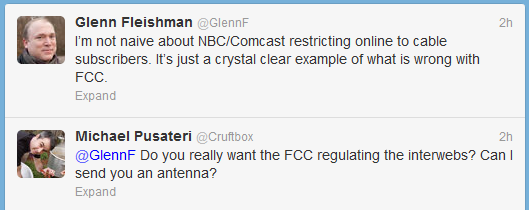
I was out on my bike ride today and stopped for a coffee.  I checked the Twitters, as you do, and saw a tweet by my friend Glenn.  I made a quick reply.

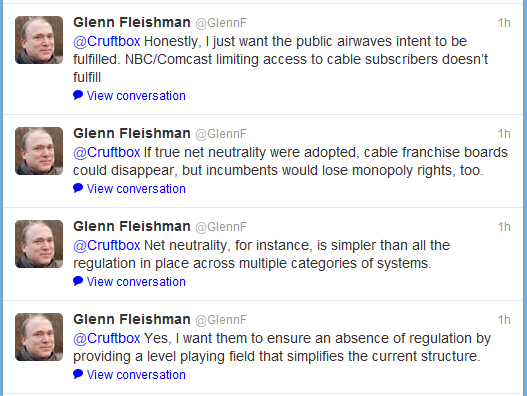
To which Glenn shot back:

That’s too much to reply back to on my phone via Twitter, so now that I’m home, so I can be clear and a little more verbose about why we don’t want the FCC getting into the business of content on the internet.  They’ve done a poor job on broadcast TV, so giving such a politicized group even more control is a bad idea.

Let’s be clear on the differences between over the air, broadcast television and internet video.

In the United States, the public owns the electromagnetic spectrum.  We’ve decided to license that spectrum for various uses, including to private companies for television broadcasting.  Part of the deal is that these licensors provide their service for free to people in their area and act “in the public good”.  It’s a little more complicated than that, but basically we get over the air television (OTA) for free because the airwaves belong to us.  We have the right to record this television, store it, and watch it wherever we want on any device we want.  The media companies don’t want this to be so, but the courts have ruled this way consistently.

The internet is a different story.  The internet is mainly a collection of private networks that are joined together with peering agreement to enable the global connectivity we all enjoy.  In the US, the FCC partially regulates internet access companies, because in many cases the companies enjoy monopoly or duopoly status due to their heritage as cable television and telephone companies and their agreements with local governments (the cable franchise boards Glenn mentions) that allow tearing up streets, easements, and string lines overhead.  But the internet does not belong to the public.  The public doesn’t own the Olympics either.

To force the television broadcasters to stream their content over the internet for free is wrong because we don’t own the internet or the content being shown, all we own is the radio spectrum.  The intent of the ‘public airwaves’ is that we get what the airwaves are used for free.  Expecting otherwise with like saying “I get free water from the fountain at the public park, so I should get free soda at McDonald’s.”  They are two completely different situations and the public’s rights are considerably different.

The FCC net neutrality discussion should be focused on access, not content control.

What combined broadband/media distribution companies would love to put in place is pricing based on KINDS of internet sites you visit.  Nothing would make them happier than to be allowed to charge a premium to visit Netflix and Hulu.  The ramifications of this would terribly restrict competition, innovation, and freedom of speech. THIS is what net neutrality should aim to prevent.

I don’t have a problem with broadband providers charging more for excessive usage or higher speeds.  Sure it sucks, but it’s my choice of what speed/amount of access I want.  Just don’t restrict my access to anywhere on the internet I want to go.  Just like I have a choice of what car I want to buy at widely varied prices and buy whatever gasoline I want, I expect to drive my car on any road I want.

To ask the FCC to start meddling in how media companies deal with the internet and forcing them to do things because of over the air television paradigms is misguided.  Enshrining government intervention into the rapidly evolving digital media marketplace is a sure way to stifle innovation and avoid competition.

Already you see things like Aereo popping up to disrupt the control that OTA broadcasters have on television online.  Let’s let innovation solve these problems, not politicians.

Yes, it sucks that much of the digital Olympics coverage is behind a paywall.  But we all have many options from using an antenna to having a UK based VPN to paying for cable/satellite to relying on pirate retransmissions.  If NBC makes bad choices in how they serve the public online, they will pay for it in the long run as the marketplace walks away from them.

NBC paid for the rights to broadcast the Olympics. Anyone with the cash could have outbid them, with or without a OTA outlet. Compare it to DirecTV, who pays a huge amount for exclusive rights to the NFL games, preventing digital distribution by NBC, CBS, and FOX (the OTA broadcasters). Should the FCC force DirecTV to allow NFL games to be streamed for free as well, just because they air on local stations?  How far down this rabbit hole do you want to go?

Again, I’m not trying to defend NBC, just to point out that the answer to this kind of problem is not to legislate it away.  Just like any trouble on the internet, the answer is to route around the damage.

Patience.  Patience my friends, solve your own problems, and you will get what you want in the end.

“The future is here, it’s just not evenly distributed.” – William Gibson


What comes next

Discussion on the interwebs about the much desired HBO Go has heated up again with the launch of takemymoneyhbo.com.

Longtime readers of FoTV will remember my post on Why HBO won’t sell you HBO Go. Where my basic premise is that the economics just don’t make sense for HBO.

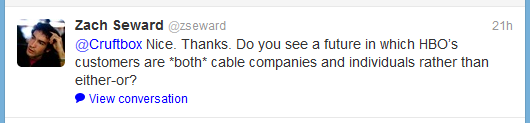
In the twitterverse I got a reply from Zach Seward of Cordcutter where he asks:

“Do you see a future in which HBO’s customers are *both* cable companies and individuals rather than either-or?”

I do see this in the future, but IMHO we have a big transition to go through for both the consumer and the media industrial complex.

The next step will be Over-The-Top (aka OTT) Television. OTT has a few meanings, depending to whom you talk to. Some say OTT is any video delivered via broadband. To me, this a worthless definition. Everything will be delivered via broadband whether Youtube, Netflix, or Facebook videos. A clearer defintion is needed.

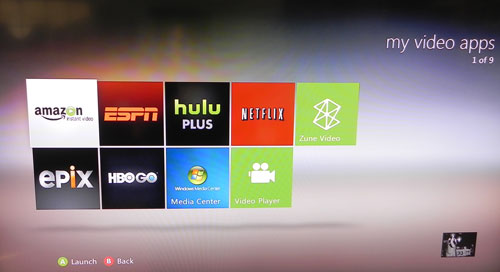
To me, OTT is the replication of an existing cable/satellite service with live video, DVR capability, and VOD capability delivers via broadband accross a variety of platforms running applications. The application environment is widespread on smart TVs, Blu-ray players, PS3 and Xbox 360 gamin consoles, and specialty devices like Roku and Apple TV. Imagine being able to have a full cable TV experience via an app downloaded to your XBox 360 without the need for any contract, truck roll, or hardware installation.

Once this type of OTT appears, the real battle over video distribution will take place. There are many things that will need to get worked out as this happens, net neutrality, broadband QoS, keyboard entry via remotes, authentication and localization, and the embrace of OTT across the chasm to the early majority. Describing this is probably a whole blog post in itself.

But once a significant portion of viewers are in the broadband OTT environment, the tipping point will have been reached. (Am I using enough industry consultantese?) At this point, with the majority of issues worked out, the market for a la carte content like HBO Go will be viable and likely available. It will arrive with much wailing ang gnashing of teeth, FUD, and declarations of the ‘end of media’, but it will arrive.

To jump from today’s environment where tech saavy people are constantly called by family to get “the Netflix” working on their Walmart Blu-ray player and have to explain the concept of getting internet access to the living room to people with VCRs still flashing 12:00 is simply a bridge too far.

We needed VCRs to get in place the business deals, consumer understanding, infrastructure to enable DVDs, true a la carte video distribution will require OTT to become more than a minor niche inhabited by enthusiasts.

Yes, I know this doesn’t make people happy to read this.  I understand.  When I got my first  Nokia 3650 in 2002, I knew the future was in the smartphones, but why did they have to suck so much in the beginning?  Ten years later and the world is completely different. We had to step through wireless data improvements, financial transaction models,  application environments, and an upending of the traditional phone carrier relationship to get here. Try to remember that the first iPhone didn’t have 3rd party apps. It took a year of working out the technical details, building backends, and developing business relationships to enable the Apple App Store.  It’s easy to forget all the baby steps it took to get to today’s mobile nirvana.

So to answer Zach’s original question, yes, we’ll get there where media companies have direct relationship with consumers, but it won’t until a lot more blood is shed in the distribution wars, product launches and failures, and endless tweets are typed with clenched fists.

Why HBO won’t sell you HBO Go

Hell hath no fury like a geek scorned, especially when you keep them away from a beloved fantasy show.  With the recent arrival of the second season of Game of Thrones and approaching return of True Blood on HBO, the interwebs of posts and discussions, both requesting that HBO sell HBO Go ‘a la carte’ and explaining how to pirate the shows. This widely circulated article crowns Game of Thrones as the most widely pirated of 2012.

HBO Go looks great, functions well, and has what people want – great content. It’s so great, people are willing to pay for it.  So why can’t you buy HBO Go without paying for cable?

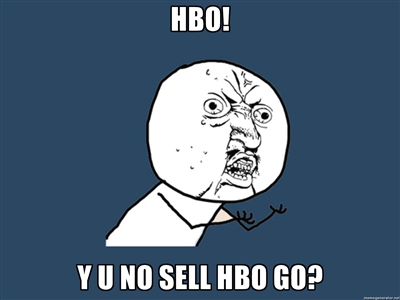
Y U NO SELL HBO GOTo understand why you can’t buy HBO Go a la carte, you first need to see things from HBO’s point of view.  When HBO thinks about what their product is and who their customer is, it’s very different than what you might imagine.  HBO’s product is not viewers or ratings and it’s not good television programming.

HBO’s product is cable subscriptions.  HBO’s primary purpose is to get people to sign up for cable and satellite subscriptions.  That is where they make a huge majority of their revenue and the core basis of their fiscal planning and success.

This has been going on a while.  When the Sopranos was popular, there were entire billboard campaigns advertising to subscribe to cable to be able to watch the show.  And it was very, very successful.  Seeing that this kind of Emmy winning programming was able to directly drive cable company results, the game changed for HBO.

Pouring more money into making great shows, they made themselves viewed as an essential channel, able to command much more money from the cable and satellite distributors.

HBO’s customer is not the viewer at home or advertising agencies.

HBO’s customers are the cable and satellite companies.  The same companies that ‘cable cutters’ are trying to get away from are the ones that HBO sees as it’s primary customer.

And why wouldn’t you want them as your customer?  They pay billions of dollars, are willing to sign 8-10 year contracts, and help market your brand.

As well written, passionate, threatening, pleading, and angry as postings on the internet are, they simply can’t compare to the cold hard cash and spreadsheets that drive HBO’s decision to use HBO Go to drive cable subscriptions and not direct revenue.

They are not alone in this.  The entire TV Everywhere ecosystem is being built to help try to buttress and reinforce the value of paying for a cable or satellite subscription.  Many different networks and channels are signing on to the plan, because of the same fact of who their primary customer is currently.

Yes, you don’t pay now and will just pirate the show instead of paying for it and that’s lost revenue to HBO.  Yes, but looking at the scale of possible conversions to paying a la carte versus angering the cable companies, it’s a no brainer to ignore the loss to downloading.

Yes, the internet is changing distribution models and the current system can’t last. Yes, but as long at the billions flow and the executives involved are rewarded for revenue numbers and not innovation, don’t expect change in the existing model.

Yes, it’s pissing you off and you’re shaking your fist at the stupidity.  Yes, but when the distribution wars start in earnest and over-the-top television begins to crack the models of the existing distribution system, the future becomes unpredictable and who knows what’s going to be the winning paradigm.

But until the glorious future arrives, HBO will keep their content behind the walls of the cable and satellite companies, reaping huge profits and ensuring an endless stream of frustrated blog posts, angry tweets, and busy bittorrent trackers.

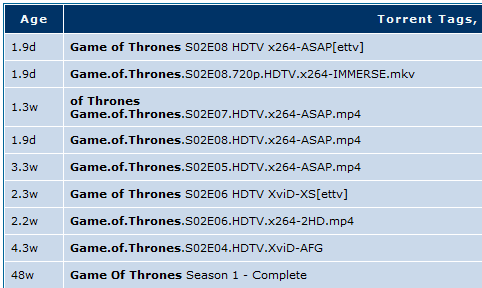
Game of Thrones torrents

What is Netflix doing talking to cable companies?

Across the interwebs, people are rolling their eyes as they read the Netflix is in discussions with cable companies to bundle services. The ‘cable cutter’ community is near apoplectic over this.

luke_nooo

The reality is that Netflix is positioning themselves for the long game here.

Remember, Netflix is most interested in Netflix’s survival and profits. They are not focused on your hatred of the cable companies.

Revenue – With cable and satellite penetration well over 80% in the US, we are looking at over 100 million households paying a monthly fee for entertainment. Netflix would like to get a slice of those customer’s money. When you multiply any revenue number by millions, the result is big. By bundling with cable companies, Netflix gets the possibility of vastly increased revenues by tapping into these traditional viewers and exposing them to the Netflix service. Getting the ‘late majority’ and ‘laggards’ to see and learn about the Netflix service is a huge benefit to Netflix.

Content distribution – Netflix has been looking into creating it’s own content, like Hulu and Amazon, to bolster it’s attractiveness to viewers. Creating good television content ain’t cheap, so Netflix is going to want maximize the demand for it to get a good return on their investment. The more people that get a chance watch their shows, the more likely they are to get a bonafide hit. Getting a hit that is Netflix-only would be huge. When the Sopranos was airing, HBO created entire campaigns to drive cable subscriptions and package upgrades simply on the desire of viewers not to miss the show. If Netflix can get enough eyeballs on good content they make, the have a good chance to significantly increase subscribers.

Net Neutrality – The situation in the US is bit strange considering the that major providers of broadband are also the major providers of television programming. We see this surface in the debate known as ‘net neutrality’. The broadband providers don’t want consumers to be able to get content without having to subscribe to their programming service. Over The Top type services like Netflix, Hulu, Amazon, and Apple need the broadband pipes to stay open and unmetered. If Netflix can strike agreements with the cable companies that control broadband, they can protect themselves from being frozen out in a broadband toll situation.

world-domination

Again, Netflix is aiming to be in every home, whether they be tech enthusiasts or not. What better way to get into people’s homes than to be invited in by the cable company that is already there. While Netflix would love to eventually love to supplant cable & satellite as primary in the home, they are happy to form a temporary alliance if it fits their long term goals. To paraphrase Machiavelli, “Keep your friends close and your enemies closer.”

A quick take on Aereo

Recently, a new company called Aereo was announced. Backed by Barry Diller’s IAC group, the company has sound funding and will launch in New York City.

Basically, it allows NYC viewers to watch over the air television wherever they want ala Slingbox and wherever they want ala DVR.

The legal basis for the service is fairly clear. The courts have ruled that people can watch television they are entitled to watch, like off-air TV, when they want, wherever they want to. This is called timeshifting or placeshifting. Extensive use of DVRs and Slingbox devices are all based on these rulings.  Keeping the recording “in the cloud” is has also been ruled on before. Known as a Network DVR, the idea that a service provider can store a television recording on your behalf as long as you are legally entitled to it was made clear in the Cablevision case.

So the two main features of the service are perfectly valid as long as one small point of fact is ensured. A user of these services needs to be legally entitled to view them. In the case of a NYC resident viewing NYC off air television, all this means is proving they live in New York City.

This is where that tiny antenna comes into play. Now my formal training in antenna theory was about 20 years ago, but I don’t think physics has changed too much since then, so I think I’m safe to say that a thumb sized antenna will get exceedingly poor reception of HD UHF channels. Especially in NYC where the problems with multi-path are legendary. But in this case, that’s OK.

My guess is that all the antenna has to do be able to show that the person using Aereo can actually receive a TV signal from NYC stations. All they need is proof that the viewer’s antenna is physically in the NYC area and the rest is easy. Even if the antenna is rented (like a satellite receiver or cable set-top box), the legal precedent applies.  Aereo is able to create the legal fiction necessary to fall within the confines of the previous rulings.

This legal argument is quite different than the one attempted by Ivi to provide a similar product.  Aereo is completely avoiding the rules of retransmission consent and must carry since they are not a cable company.  Positioned as a personal service based on the rental of an antenna, it’s legally more similar to apartment renters paying to share a common antenna on top of a building.  No one would suggest that renters in an apartment are not allowed to record their TV shows because they share an antenna.

saleve from my room

I’m speculating here that the Aereo folks put up some very nice UHF antennas to pull down all the channels cleanly. Maybe they use a large array of small antennas to get the same result. Next, they convert the baseband video into a streaming video feed that they can rebroadcast over the internet to validated customers. This is fairly trivial stuff today. Next, they built a system that records every TV show that airs on each channel. Again, not hard to do these days.

When a viewer tells Aereo that they want to record/DVR a show, all Aereo does is make a note that a particular viewer has access to that particular show. The key point being that the viewer is requesting the show first. The playback technology is the same as what Netflix, Hulu, and others use. Again, not rocket science.

Slap a billing system, authentication, a channel guide front end in place, build an iPad app, and you have Aereo.

The platform is perfect to make beachhead in the Over The Top marketplace so that the addition of cable channels becomes a trivial expansion. $12 for local TV channels, $30 for local TV plus basic cable will be the next likely step.

I have to say, it’s a smart plan.

The studio and cable attorneys are likely trying to come up with some justification for a court order to stop, but the Aereo and IAC attorneys probably have the rebuttal justifications already written citing all the precedents that allow it.  They likely have more attorneys on staff than engineers at this point.

Moving to another city is fairly easy. Install another set of antennas in a new town, backhaul the feeds to a central data center, and immediately they can bring up another city without any truck rolls, set top boxes, or even offices in that city. DirecTV did a similar thing when they began to offer local channels, by building these exact type of antenna and backhaul systems.  Avoiding all the infrastructure costs that cable and satellite providers carry when adding customers will be key to offering a comparable, but lower cost product.

All of the basic technology has been tested and proven by others and Aereo is putting it together in a new way that is scalable, low cost, and in the long run, profitable.

When it comes to Los Angeles, I’m definitely giving it a try.