The quick fix is the wrong fix

I was out on my bike ride today and stopped for a coffee.  I checked the Twitters, as you do, and saw a tweet by my friend Glenn.  I made a quick reply.
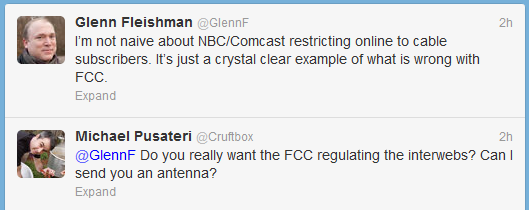
To which Glenn shot back:
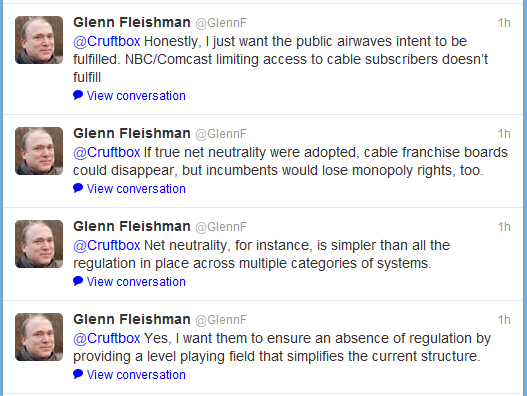
That’s too much to reply back to on my phone via Twitter, so now that I’m home, so I can be clear and a little more verbose about why we don’t want the FCC getting into the business of content on the internet.  They’ve done a poor job on broadcast TV, so giving such a politicized group even more control is a bad idea.

Let’s be clear on the differences between over the air, broadcast television and internet video.

In the United States, the public owns the electromagnetic spectrum.  We’ve decided to license that spectrum for various uses, including to private companies for television broadcasting.  Part of the deal is that these licensors provide their service for free to people in their area and act “in the public good”.  It’s a little more complicated than that, but basically we get over the air television (OTA) for free because the airwaves belong to us.  We have the right to record this television, store it, and watch it wherever we want on any device we want.  The media companies don’t want this to be so, but the courts have ruled this way consistently.

The internet is a different story.  The internet is mainly a collection of private networks that are joined together with peering agreement to enable the global connectivity we all enjoy.  In the US, the FCC partially regulates internet access companies, because in many cases the companies enjoy monopoly or duopoly status due to their heritage as cable television and telephone companies and their agreements with local governments (the cable franchise boards Glenn mentions) that allow tearing up streets, easements, and string lines overhead.  But the internet does not belong to the public.  The public doesn’t own the Olympics either.

To force the television broadcasters to stream their content over the internet for free is wrong because we don’t own the internet or the content being shown, all we own is the radio spectrum.  The intent of the ‘public airwaves’ is that we get what the airwaves are used for free.  Expecting otherwise with like saying “I get free water from the fountain at the public park, so I should get free soda at McDonald’s.”  They are two completely different situations and the public’s rights are considerably different.

The FCC net neutrality discussion should be focused on access, not content control.

What combined broadband/media distribution companies would love to put in place is pricing based on KINDS of internet sites you visit.  Nothing would make them happier than to be allowed to charge a premium to visit Netflix and Hulu.  The ramifications of this would terribly restrict competition, innovation, and freedom of speech. THIS is what net neutrality should aim to prevent.

I don’t have a problem with broadband providers charging more for excessive usage or higher speeds.  Sure it sucks, but it’s my choice of what speed/amount of access I want.  Just don’t restrict my access to anywhere on the internet I want to go.  Just like I have a choice of what car I want to buy at widely varied prices and buy whatever gasoline I want, I expect to drive my car on any road I want.

To ask the FCC to start meddling in how media companies deal with the internet and forcing them to do things because of over the air television paradigms is misguided.  Enshrining government intervention into the rapidly evolving digital media marketplace is a sure way to stifle innovation and avoid competition.

Already you see things like Aereo popping up to disrupt the control that OTA broadcasters have on television online.  Let’s let innovation solve these problems, not politicians.

Yes, it sucks that much of the digital Olympics coverage is behind a paywall.  But we all have many options from using an antenna to having a UK based VPN to paying for cable/satellite to relying on pirate retransmissions.  If NBC makes bad choices in how they serve the public online, they will pay for it in the long run as the marketplace walks away from them.

NBC paid for the rights to broadcast the Olympics. Anyone with the cash could have outbid them, with or without a OTA outlet. Compare it to DirecTV, who pays a huge amount for exclusive rights to the NFL games, preventing digital distribution by NBC, CBS, and FOX (the OTA broadcasters). Should the FCC force DirecTV to allow NFL games to be streamed for free as well, just because they air on local stations?  How far down this rabbit hole do you want to go?

Again, I’m not trying to defend NBC, just to point out that the answer to this kind of problem is not to legislate it away.  Just like any trouble on the internet, the answer is to route around the damage.

Patience.  Patience my friends, solve your own problems, and you will get what you want in the end.

“The future is here, it’s just not evenly distributed.” – William Gibson
 

What comes next

Discussion on the interwebs about the much desired HBO Go has heated up again with the launch of takemymoneyhbo.com.

Longtime readers of FoTV will remember my post on Why HBO won’t sell you HBO Go. Where my basic premise is that the economics just don’t make sense for HBO.

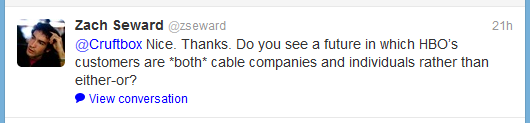
In the twitterverse I got a reply from Zach Seward of Cordcutter where he asks:

“Do you see a future in which HBO’s customers are *both* cable companies and individuals rather than either-or?”

I do see this in the future, but IMHO we have a big transition to go through for both the consumer and the media industrial complex.

The next step will be Over-The-Top (aka OTT) Television. OTT has a few meanings, depending to whom you talk to. Some say OTT is any video delivered via broadband. To me, this a worthless definition. Everything will be delivered via broadband whether Youtube, Netflix, or Facebook videos. A clearer defintion is needed.

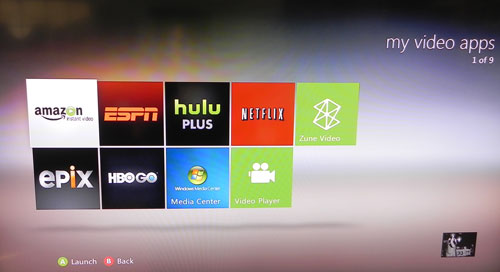
To me, OTT is the replication of an existing cable/satellite service with live video, DVR capability, and VOD capability delivers via broadband accross a variety of platforms running applications. The application environment is widespread on smart TVs, Blu-ray players, PS3 and Xbox 360 gamin consoles, and specialty devices like Roku and Apple TV. Imagine being able to have a full cable TV experience via an app downloaded to your XBox 360 without the need for any contract, truck roll, or hardware installation.

Once this type of OTT appears, the real battle over video distribution will take place. There are many things that will need to get worked out as this happens, net neutrality, broadband QoS, keyboard entry via remotes, authentication and localization, and the embrace of OTT across the chasm to the early majority. Describing this is probably a whole blog post in itself.

But once a significant portion of viewers are in the broadband OTT environment, the tipping point will have been reached. (Am I using enough industry consultantese?) At this point, with the majority of issues worked out, the market for a la carte content like HBO Go will be viable and likely available. It will arrive with much wailing ang gnashing of teeth, FUD, and declarations of the ‘end of media’, but it will arrive.

To jump from today’s environment where tech saavy people are constantly called by family to get “the Netflix” working on their Walmart Blu-ray player and have to explain the concept of getting internet access to the living room to people with VCRs still flashing 12:00 is simply a bridge too far.

We needed VCRs to get in place the business deals, consumer understanding, infrastructure to enable DVDs, true a la carte video distribution will require OTT to become more than a minor niche inhabited by enthusiasts.

Yes, I know this doesn’t make people happy to read this.  I understand.  When I got my first  Nokia 3650 in 2002, I knew the future was in the smartphones, but why did they have to suck so much in the beginning?  Ten years later and the world is completely different. We had to step through wireless data improvements, financial transaction models,  application environments, and an upending of the traditional phone carrier relationship to get here. Try to remember that the first iPhone didn’t have 3rd party apps. It took a year of working out the technical details, building backends, and developing business relationships to enable the Apple App Store.  It’s easy to forget all the baby steps it took to get to today’s mobile nirvana.

So to answer Zach’s original question, yes, we’ll get there where media companies have direct relationship with consumers, but it won’t until a lot more blood is shed in the distribution wars, product launches and failures, and endless tweets are typed with clenched fists.

Why HBO won’t sell you HBO Go

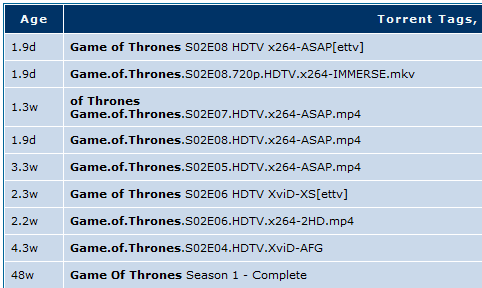
Hell hath no fury like a geek scorned, especially when you keep them away from a beloved fantasy show.  With the recent arrival of the second season of Game of Thrones and approaching return of True Blood on HBO, the interwebs of posts and discussions, both requesting that HBO sell HBO Go ‘a la carte’ and explaining how to pirate the shows. This widely circulated article crowns Game of Thrones as the most widely pirated of 2012.

HBO Go looks great, functions well, and has what people want – great content. It’s so great, people are willing to pay for it.  So why can’t you buy HBO Go without paying for cable?

Y U NO SELL HBO GOTo understand why you can’t buy HBO Go a la carte, you first need to see things from HBO’s point of view.  When HBO thinks about what their product is and who their customer is, it’s very different than what you might imagine.  HBO’s product is not viewers or ratings and it’s not good television programming.

HBO’s product is cable subscriptions.  HBO’s primary purpose is to get people to sign up for cable and satellite subscriptions.  That is where they make a huge majority of their revenue and the core basis of their fiscal planning and success.

This has been going on a while.  When the Sopranos was popular, there were entire billboard campaigns advertising to subscribe to cable to be able to watch the show.  And it was very, very successful.  Seeing that this kind of Emmy winning programming was able to directly drive cable company results, the game changed for HBO.

Pouring more money into making great shows, they made themselves viewed as an essential channel, able to command much more money from the cable and satellite distributors.

HBO’s customer is not the viewer at home or advertising agencies.

HBO’s customers are the cable and satellite companies.  The same companies that ‘cable cutters’ are trying to get away from are the ones that HBO sees as it’s primary customer.

And why wouldn’t you want them as your customer?  They pay billions of dollars, are willing to sign 8-10 year contracts, and help market your brand.

As well written, passionate, threatening, pleading, and angry as postings on the internet are, they simply can’t compare to the cold hard cash and spreadsheets that drive HBO’s decision to use HBO Go to drive cable subscriptions and not direct revenue.

They are not alone in this.  The entire TV Everywhere ecosystem is being built to help try to buttress and reinforce the value of paying for a cable or satellite subscription.  Many different networks and channels are signing on to the plan, because of the same fact of who their primary customer is currently.

Yes, you don’t pay now and will just pirate the show instead of paying for it and that’s lost revenue to HBO.  Yes, but looking at the scale of possible conversions to paying a la carte versus angering the cable companies, it’s a no brainer to ignore the loss to downloading.

Yes, the internet is changing distribution models and the current system can’t last. Yes, but as long at the billions flow and the executives involved are rewarded for revenue numbers and not innovation, don’t expect change in the existing model.

Yes, it’s pissing you off and you’re shaking your fist at the stupidity.  Yes, but when the distribution wars start in earnest and over-the-top television begins to crack the models of the existing distribution system, the future becomes unpredictable and who knows what’s going to be the winning paradigm.

But until the glorious future arrives, HBO will keep their content behind the walls of the cable and satellite companies, reaping huge profits and ensuring an endless stream of frustrated blog posts, angry tweets, and busy bittorrent trackers.

Game of Thrones torrents

What is Netflix doing talking to cable companies?

Across the interwebs, people are rolling their eyes as they read the Netflix is in discussions with cable companies to bundle services. The ‘cable cutter’ community is near apoplectic over this.

luke_nooo

The reality is that Netflix is positioning themselves for the long game here.

Remember, Netflix is most interested in Netflix’s survival and profits. They are not focused on your hatred of the cable companies.

Revenue – With cable and satellite penetration well over 80% in the US, we are looking at over 100 million households paying a monthly fee for entertainment. Netflix would like to get a slice of those customer’s money. When you multiply any revenue number by millions, the result is big. By bundling with cable companies, Netflix gets the possibility of vastly increased revenues by tapping into these traditional viewers and exposing them to the Netflix service. Getting the ‘late majority’ and ‘laggards’ to see and learn about the Netflix service is a huge benefit to Netflix.

Content distribution – Netflix has been looking into creating it’s own content, like Hulu and Amazon, to bolster it’s attractiveness to viewers. Creating good television content ain’t cheap, so Netflix is going to want maximize the demand for it to get a good return on their investment. The more people that get a chance watch their shows, the more likely they are to get a bonafide hit. Getting a hit that is Netflix-only would be huge. When the Sopranos was airing, HBO created entire campaigns to drive cable subscriptions and package upgrades simply on the desire of viewers not to miss the show. If Netflix can get enough eyeballs on good content they make, the have a good chance to significantly increase subscribers.

Net Neutrality – The situation in the US is bit strange considering the that major providers of broadband are also the major providers of television programming. We see this surface in the debate known as ‘net neutrality’. The broadband providers don’t want consumers to be able to get content without having to subscribe to their programming service. Over The Top type services like Netflix, Hulu, Amazon, and Apple need the broadband pipes to stay open and unmetered. If Netflix can strike agreements with the cable companies that control broadband, they can protect themselves from being frozen out in a broadband toll situation.

world-domination

Again, Netflix is aiming to be in every home, whether they be tech enthusiasts or not. What better way to get into people’s homes than to be invited in by the cable company that is already there. While Netflix would love to eventually love to supplant cable & satellite as primary in the home, they are happy to form a temporary alliance if it fits their long term goals. To paraphrase Machiavelli, “Keep your friends close and your enemies closer.”

A quick take on Aereo

Recently, a new company called Aereo was announced. Backed by Barry Diller’s IAC group, the company has sound funding and will launch in New York City.

Basically, it allows NYC viewers to watch over the air television wherever they want ala Slingbox and wherever they want ala DVR.

The legal basis for the service is fairly clear. The courts have ruled that people can watch television they are entitled to watch, like off-air TV, when they want, wherever they want to. This is called timeshifting or placeshifting. Extensive use of DVRs and Slingbox devices are all based on these rulings.  Keeping the recording “in the cloud” is has also been ruled on before. Known as a Network DVR, the idea that a service provider can store a television recording on your behalf as long as you are legally entitled to it was made clear in the Cablevision case.

So the two main features of the service are perfectly valid as long as one small point of fact is ensured. A user of these services needs to be legally entitled to view them. In the case of a NYC resident viewing NYC off air television, all this means is proving they live in New York City.

This is where that tiny antenna comes into play. Now my formal training in antenna theory was about 20 years ago, but I don’t think physics has changed too much since then, so I think I’m safe to say that a thumb sized antenna will get exceedingly poor reception of HD UHF channels. Especially in NYC where the problems with multi-path are legendary. But in this case, that’s OK.

My guess is that all the antenna has to do be able to show that the person using Aereo can actually receive a TV signal from NYC stations. All they need is proof that the viewer’s antenna is physically in the NYC area and the rest is easy. Even if the antenna is rented (like a satellite receiver or cable set-top box), the legal precedent applies.  Aereo is able to create the legal fiction necessary to fall within the confines of the previous rulings.

This legal argument is quite different than the one attempted by Ivi to provide a similar product.  Aereo is completely avoiding the rules of retransmission consent and must carry since they are not a cable company.  Positioned as a personal service based on the rental of an antenna, it’s legally more similar to apartment renters paying to share a common antenna on top of a building.  No one would suggest that renters in an apartment are not allowed to record their TV shows because they share an antenna.

saleve from my room

I’m speculating here that the Aereo folks put up some very nice UHF antennas to pull down all the channels cleanly. Maybe they use a large array of small antennas to get the same result. Next, they convert the baseband video into a streaming video feed that they can rebroadcast over the internet to validated customers. This is fairly trivial stuff today. Next, they built a system that records every TV show that airs on each channel. Again, not hard to do these days.

When a viewer tells Aereo that they want to record/DVR a show, all Aereo does is make a note that a particular viewer has access to that particular show. The key point being that the viewer is requesting the show first. The playback technology is the same as what Netflix, Hulu, and others use. Again, not rocket science.

Slap a billing system, authentication, a channel guide front end in place, build an iPad app, and you have Aereo.

The platform is perfect to make beachhead in the Over The Top marketplace so that the addition of cable channels becomes a trivial expansion. $12 for local TV channels, $30 for local TV plus basic cable will be the next likely step.

I have to say, it’s a smart plan.

The studio and cable attorneys are likely trying to come up with some justification for a court order to stop, but the Aereo and IAC attorneys probably have the rebuttal justifications already written citing all the precedents that allow it.  They likely have more attorneys on staff than engineers at this point.

Moving to another city is fairly easy. Install another set of antennas in a new town, backhaul the feeds to a central data center, and immediately they can bring up another city without any truck rolls, set top boxes, or even offices in that city. DirecTV did a similar thing when they began to offer local channels, by building these exact type of antenna and backhaul systems.  Avoiding all the infrastructure costs that cable and satellite providers carry when adding customers will be key to offering a comparable, but lower cost product.

All of the basic technology has been tested and proven by others and Aereo is putting it together in a new way that is scalable, low cost, and in the long run, profitable.

When it comes to Los Angeles, I’m definitely giving it a try.

OTT appears

News out of England is that Sky TV has announced a true Over The Top product that does not require buying into a traditional satellite subscription.

A quote from the official announcement:

“This exciting new service will offer some of Sky’s most popular content through a wide range of broadband connected devices. Alongside the continued growth of our satellite platform, this will be a new way for us to reach out to consumers who love great content, but may not want the full Sky service. Bringing a distinctive, new choice to the marketplace will help us meet the needs and demands of an ever wider range of consumers.”

The key point is in bold.  Sky is going to offer a broadband only viewing service that is not tied to their core broadcast service.  This is the exactly the path other services are going to consider to slide into the hearts and minds of the cable-cutters.

Looks like Sky has decided that if someone is going to eat their lunch, it might as well be themselves.  Other takes on the news at Engadget and the Wall Street Journal.

With the US based DirecTV crossbred with Murdoch DNA in the past, I wouldn’t be surprised to see them attempt a similar product to distance themselves further from the cable focus on TV Everywhere.

Looking both ways

Two interesting tidbits in the news that showcase the television industry being stuck between the past and the future.

Article in the New York Times about the ratings game the networks play:

In Networks’ Race for Ratings, Chicanery Is on the Schedule

“This is the kind of programming sleight of hand that executives seize on as they seek to gain every possible edge in the television ratings game, at a time when each tenth of a point or two enhances their standing in the nightly ratings and the ability to pitch to advertisers who spend billions of dollars a year. But these tactics are more about bragging rights than money.”

As the industry moves to direct measurement of ratings of viewing and away from the Nielsen survey style, these gimmicks will disappear, and seem laughable in hindsight.  The online industry is not immune to such silliness.  Consider the endless amount of top ten lists that require you to click ‘next’ 10 times to see the whole article, simply to increase the number of page views.

Article in Variety discussing News Corp President Chase Carey’s take on TV Everywhere:

Chase Carey: Not impressed with TV Everywhere

“Carey didn’t mince words on how badly he believes cable, satellite and telcos have botched extending program viewing to digital platforms at no extra charge to subscribers who access content via authentication.”

The major cable and satellite distributors are counting on TV Everywhere to help reign in the proliferation of free content on the web and maintain the perceived value of subscriptions.  Many inside the studios like the idea of TV Everywhere because it basically creates a whole new product they can sell or barter with in negotiations with the distributors. Carey’s words are very much in line with the consumer research that show TV Everywhere as frustrating to viewers looking to replicate a simple television experience on a computer or iPad.

Nothing is over

The widespread grassroots protests and blackouts against the SOPA and PIPA bills effectively killed these incarnations of new copyright policing. Many are congratulating each other on a job well done, and rightly so.

But don’t think this debate is over.  To quote John Rambo, “Nothing is over.”

What the protests did was reduce political support, raise general awareness, and most importantly get the issue talked about on The Daily Show.

To understand what’s driving this kind of legislation requires a little insight into the thinking within the large companies.

Contrary to popular belief, executives at large media companies are not the Nazgul.  They are not insane villians plotting world domination.  For the most part, they are nice people that you probably would find interesting to talk to over drinks.  I spent the majority of my adult life working with these people.

The media executives know it’s a losing battle.  They are going after locker sites like MegaUpload because then know they can’t do anything about newsgroups and private darknets.  They continue suing bittorrent users even though they know it’s bad PR and doesn’t stop piracy.  They still try to do things like “plug the analog hole” and down-ressing HD content even though it’s a complete waste of time and does nothing to prevent piracy.

What many people need to learn is why?

Why in the face of such a daunting task, do media companies continue to hammer away with things like SOPA and PIPA?

hollywood y u

If you read some of the posts on the interwebs, they would have you believe that the reasons these bills are being pushed are things like this:

  • They hate freedom
  • They don’t understand fair use and/or copyright law
  • They want to censor what you say
  • They are part of a government plot to block political speech
  • They hate puppies and kittens, cheer for Darth Vader & the Daleks, and eat your children

While those reasons do make people get riled up, and I have pondered about the white armor I’ve seen stashed in various corporate closets, the reality is far different and much more mundane.

Here are the real reasons that SOPA & PIPA were proposed, and the reason why lobbying for similar things will continue in the foreseeable future.

The Stock Price – Every three months the companies have to release financial figures that are looked at by Wall Street analysts to determine if they get the thumbs up or thumbs down.  The stock price is very, very, VERY important to the top executives in media companies because it determines if they will continue in their job and how much of a bonus they will get.

paranoid parrot

Media companies love to point to piracy as claim of losses to justify lower profits.  A lot of effort goes into creating “piracy loss” estimates, just to help the various CFOs justify the earnings.  It’s much easier to say, “If it wasn’t for all these pirates, we’d have made more money!” than saying “Our fundamental business model is changing and it’s unclear where we’ll be in five years.”

The method used to estimate the losses would receive an F if submitted in a college course.  Yes, there is some loss of revenue to piracy, but the methods, logical leaps, and invention of numbers utilized in these reports are completely unsupported.  They are so bad, that there’s even internal debate about how full of crap the estimates are.

Contracts with Talent – The term ‘Talent’ refers to the creative people that do the acting, writing, directing, and others that turn ideas into entertainment.  Groups like the Director’s Guild, Writer’s Guild, SAG, AFTRA, and IATSE all insert language into contracts that force the studios to use things like DRM and agreed to aggressively pursue copyright infringement.  The logic of the guilds is simple; every product that is pirated instead of sold is less money to their members.

Contracts with Distributors – Cable & satellite providers, television networks, mobile providers, brick and mortar stores, and digital media outlets all pay a huge amounts for the right to use, sell and retransmit content from the studios.  They don’t want people getting the content for free.  As a result, contracts with distributors have language that requires the media companies to crack down on piracy.  Combined with the insistence on DRM by the Talent and Studios, you have an interlocking set of agreements that basically prevent anyone for advocating an unsecured solution or allow them to ignore piracy.

Legal Standing – Beside the person at home downloading shows via a torrent or newsgroup, there are some serious criminals operating on pirated content.  There are entire companies devoted to creating counterfeit DVDs, Blu-Rays and other versions for sale in Asia, Russia, and the Middle East. Even in Los Angeles, home to Hollywood, you can visit Santee Alley and buy counterfeit discs.  To combat this organized criminal effort involves a lot of lawyers.  IANAL, but from the legal point of view, the media companies  want to show that they have tried every possible way to stop piracy and that the counterfeiters are actively going around these measures.

sue internet

The reason behind the FBI warning is not to deter anyone from pirating content, it’s simply to be able to say in court, “This person saw the FBI warning, knew what they did was illegal, and can’t claim ignorance.”  Just like if you buy a toaster, the manual will warn you not to stick a fork in it.  Not to educate you, but to use against you in court if you sue them later, after sticking a fork in your toaster.

International Distribution – Critical to the media business is selling content made in one country to distributors in another country.  The value to the buyer comes from being able to get the eyeballs/sales via their distribution conduit.  The value drops dramatically if it’s available for free.  This is why you see so much geo-blocking to prevent Europeans from viewing video on American sites and vice versa.  The studios have had to drastically revise their release windowing schemes to help reduce the amount of piracy, but even a couple day delay is too much for some passionate viewers.  Contracts require the studios to fight piracy aggressively.  I’ve been in the room when distribution partners turn a laptop around, show a streaming version of a show, and say “Why should we pay you £200,000 per episode when people can get it for free?”

Piracy does cause lost revenue – As much as people don’t want to admit it, piracy does cause a loss of revenue to the studios, and as a result, people on all sides make less money.  Many people try to justify this by saying that those people are already rich, but it doesn’t make it any less true. There are many people without a lot of extra money to pay for movies or cable that pirate content to stay entertained.  I can’t say I put a lot of blame on those people.  But, I do know several people that have literally made millions of dollars on internet companies that don’t pay for cable, but do pay for elaborate downloading set-ups with newsgroups, auto-downloading, media centers and TV set-ups that would make Hollywood moguls jealous.  The truth is that many of the people that participate in illegal downloading could pay for the content, but simply don’t.

interwebs win

The point is not to justify the tactics of the media companies; it’s to help educate people on why things like SOPA and PIPA get proposed.  Until the underlying issues start to change, the lobbyists will still get paid, and the politicians will bring up new legislation.

The music industry has already begun to start resolving their versions of these issues, but not without suffering a near-death experience.  What will it take for change in the television and film industries?  Probably a lot more change in the marketplace with new competitors bringing new ways to watch television and movies.  But remember, the media companies are well funded, well armed, and like Rambo, ruthless with people that they view as the ones that started the fight.

Understanding the true drivers in the Copyright Wars is critical to creating a reasonable and effective response.  Logic and reason should guide grassroots organizations, not raw emotion.

“If you know the enemy and know yourself, you need not fear the result of a hundred battles. If you know yourself but not the enemy, for every victory gained you will also suffer a defeat. If you know neither the enemy nor yourself, you will succumb in every battle.” – Sun Tzu


Kill Hollywood? I know Hollywood, and you’re not killing Hollywood.

The new hotness is to talk about how “the Internet” is going to “kill Hollywood” and that “old media is dead”.

A few of the posts I’m referring to are from smart, sharp people like Marc Suster, Paul Graham, and Rex Sorgatz.  They vary a little in theme, but all discuss the basic idea that the old way of doing business in television and film is going to change at a fundamental level.  Accelerating the thinking is the clash over copyright which is really a clash over revenue generation and competition.

While people are right to see significant change coming to how media is distributed and consumed, they are wrong to think that changes in technology are going to destroy the basic processes that exist today in what is considered “Hollywood”.

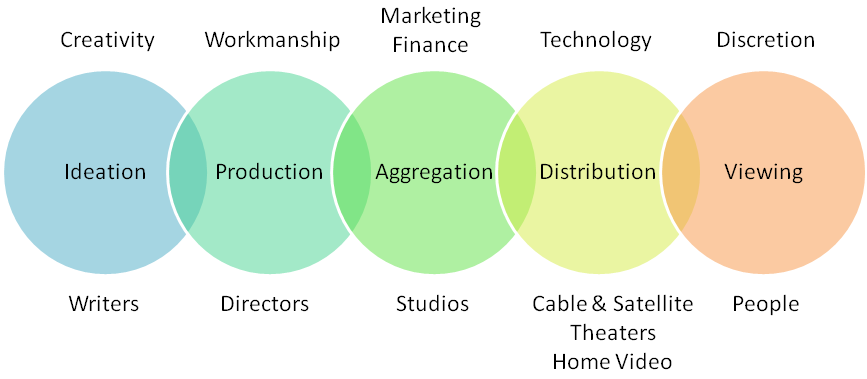
Let’s look at a model of how ideas become shows and movies.

Media Flow One

The Five Steps

Ideation – The creation of new stories, concepts or presentation of existing ideas into a new package that would be engaging to viewers.  This is the realm of the writers and producers where the cool, new stuff is conceived.

Production – The actual creation of the film or television program.  This is the realm of the director, actor, cinematographer, musician, gaffer, best boy, make-up artist, special effects, and an endless amount of other experts in specific fields where experience and technique is required.

Aggregation – The process of sorting the bad from the good and the marketing of the good to people.  This is the realm of the Studios, green lighting films and shows, helping coordinating in the realms of Production and Distribution, and most importantly, making people aware of what is being created.  This is the “Hollywood” that many speak of with derision.

Distribution – The process of getting films and shows to people that want them.  This is the realm of cable & satellite providers, theaters, digital distribution, “piracy”, and plastic discs.

Viewing – The consumption of creative product by people.  Taking a variety of forms, it’s entertainment for people in a plethora of genres and forms.

Skills That Power The Steps

Creativity – New concepts and ideas are the engine of the entire entertainment industry.  Without creativity, entertainment stagnates, becomes repetitive, and fails to attract an audience.

Workmanship – Expertise, innovation, and precision are what create immersive and engaging entertainment.  Without workmanship, there can be no ‘suspension of disbelief’.

Marketing – Helping people understand the new entertainment being created and framing it into something people think will have value is essential to getting new ideas into the world.  Without marketing, the entire process would fail as people are not motivated to try new entertainment.

Distribution – Getting content to people in a variety of formats and delivery methods.  Without distribution, even the greatest stories remain untold.

Discretion – In the end it’s the decision of the viewing public as to whether content is good and has value to them seen in the form of ratings, box office receipt, purchases.  Without viewer discretion, good things don’t surface and bad things stick around.

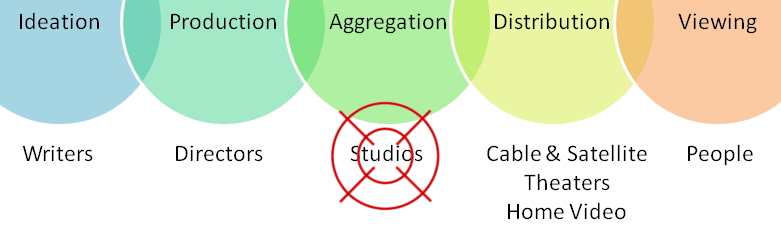
Who Exactly Are You Trying to Kill?

Now that the model is clear, let’s examine what part of this would be affected by “the Internet”.  The recent calls to “kill” are almost solely focused on Technology.  That means new and alternative ways to distribute content.  So the key idea is that the rapid pace of change in technology is going to bring down the Hollywood studios.


Let’s look at that claim in context of the technology change in the 20th century.

The modern studio structure begins in the early 20th century with movie theaters as primary distribution.

  • Broadcast Television comes along, studios adapt, create content for it, turn it into a billion dollar industry.
  • Cable Television comes along, studios adapt, create content for it, turn it into a billion dollar industry.
  • VHS Tape comes along, studios adapt, create content for it, turn it into a billion dollar industry.
  • DVDs comes along, studios adapt, create content for it, turn it into a billion dollar industry.
  • Digital Downloads comes along, studios adapt, create content for it, turn it into a billion dollar industry.
  • Internet streaming video comes along, studios adapt, create content for it, and are in the process of turning it into a billion dollar industry.

Changes and innovation in technology alone are not going to “kill Hollywood”.  Do you really think that the content producers can’t or won’t adapt to the new distribution methods and revenue models?  Of course they will.  They have every time in the past.  Change is hard, so first they fight it and then they accept it and turn it into a billion dollar business.

Competition, not Assassination.

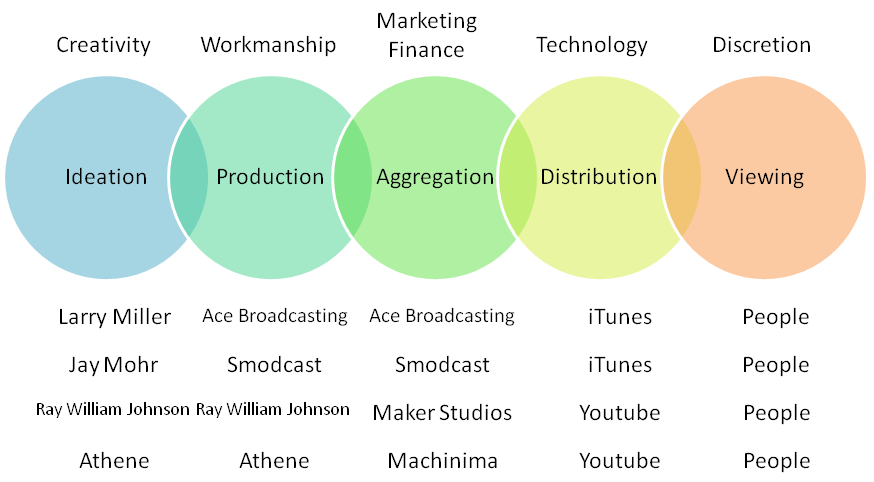
Let’s look at some of the new, innovative companies out there that are pointed to as examples of new media, Maker Studios and Machinma.  Often they are heralded as the “future of television”.  They make some great stuff, I watch plenty of it, but they are following the exact same overall model as the big Hollywood studios.

Ray William Johnson – Ideation, Production
Maker Studios – Marketing, Finance
Youtube – Distribution

Athene – Ideation, Production
Machinima – Marketing, Finance
Youtube – Distribution

You could swap out a different distribution method and it wouldn’t affect the other steps.  The model continues and the new studios become more like the older studios.

Media Flow Two

Even in podcasting, you are seeing the rise of podcast studios like those from Kevin Smith and Adam Carolla, using exactly the same model.  Even podcast coming out of the tech space like Revision3 and TWiT follow the model.

Looking at gaming, we see exactly the same model occur as well.  The studio Activision owns  and markets Blizzard/World ofWarcraft and Infinity Ward/Call of Duty games and distributes via download and discs.  The studio EA owns and markets The Sim Studio/Sims games and distributes via download and discs.

Yes, improvements in technology make to the other steps of the model easier, but they don’t break the model.  All of the transitions in technology may change how content is created, distributed, and viewed, but they don’t kill anything except old technology.

Perhaps a new form of entertainment will emerge, but it won’t be from the technology side.  New entertainment comes from the creativity side.  With Silicon Valley and Alley so focused on the next technology, they don’t have much knowledge or experience in start-ups focusing on creativity.  There is no minimal viable product in entertainment.

Billions of Dollars, Waiting to be Picked Up

The modern studio system is full of inefficiency, bloat, tradition, groupthink, and plenty of just plain stupidity, but it does get the job done and remains orders of magnitude more popular and profitable than any other form of entertainment.  The industry is so focused on playing defense and guarding the backdoor against piracy, that people with good new ideas can simply walk in the front door and Hollywood will think they’re there to help.

There is a huge role for technology start-ups to play in improving and innovating in the world of entertainment, but it starts with understanding how entertainment go from ideas to eyeballs and working with experts in other areas rather than stating they want to kill them.


Inside the fortress

You are a digital media or technology executive within one of the large media companies.

You are bright, articulate, and able to grab complex concepts and relationships.  You “get it” quickly in the first five minutes of the hour long meeting.

You see the inexorable changes happening in television and film and understand we are living through a fundamental shift in the business model that your company thrives on.  You see the disruption happening and know that serious change and risk taking is needed to meet the expectations of the public and the shareholders.

You are expected to know everything about every new media device, technology, start-up, and business model.  You get called into meetings at the tail end of deals to explain what the biz dev guys just agreed to without understanding the cost or difficulty to do.  You demo new products and concepts to people that hate what you are showing them.

You understand that piracy is unstoppable and should be regarded as a competitor that cannot be sued out of existence.  Pretty much all your friends regularly grab your content from newsgroups or torrents, complain about geo-restrictions, and ask you why your company is “so stupid”.  You are asked why there isn’t ala carte cable, live network streams on the internet, new movies on Netflix, old shows and movies simply not available anywhere, and all you can do is shrug and say, “It’s very complicated.”

Your team is understaffed, overworked, and called upon to make things based on what lawyers and MBAs dictate, not what any viewer would want or use. Every now and then you get to make something cool, but mainly you are asked to make something useless because a creative executive read about in Wired magazine or Variety said another studio was doing it.

Your company holds the ‘creatives’ in highest regard.  Those that make and produce content are treated as aristocrats and you are expected to cater to their every whim.  They pride themselves on technical ignorance and don’t use most of the media technology that is commonplace to every teenager in the country.  They can do no wrong until they are fired and thrown from the parapets to the moat below.

You work with the attorneys that expect help in finding ways to break the internet.  You heard them planning SOPA and PIPA years ago.  You are expected to develop ‘defensive’ patents. You are told to put in geo-fencing, DRM, secure streaming, and every possible security measure to protect content at the same time the Marketing Group is sending out DVDs of content that is unreleased to critics and distributors months in advance.  When music from shows leak to Youtube and gets thousands of likes, and you are expected help take it down and figure out how it got there.

You are asked to develop ways to help the incumbent cable and satellite providers maintain their lock on consumer by pulling more content off of free sites and put it behind paywalls.  You go to meetings about this with people from other companies like yours during the day, and later over drinks at night say, “Can you believe we are building this shit?” You review the contracts that require insane things like down-rezzed HD content and blocking “analog holes”.

You see the interlocking web of agreements between producers, writers, actors, musicians, studios, cable and satellite companies, mobile phone providers, international distributors, and everyone else in “the business” that attempts to preserve the existing revenue stream and lock consumers into contracts that bind them for years at a time.

You discuss how exclusivity leads to piracy, and it is explained to you that the billion-dollar customers get whatever they want.  You explain how DRM leads to even more piracy, and it is explained to you tha the talent contracts require it.  You discuss the Innovator’s Dilemma, and it is explained to you it doesn’t apply to the media industry.  You discuss the impact of ubiquitous broadband on the cable and satellite providers, and it is explained to you that the cable and satellite ‘have a plan’ on how to deal with internet TV.  You say “If someone’s going to eat our lunch, it might as well be us.”

Your boss talks to you and says, “You’re right, but never disagree with the people in the room.”  You know he’s saying this because somebody complained about you.

You see the start-ups wandering in the weeds, ignorant of the web of contracts and agreements designed to stop them. You see the consumer electronics manufacturers building insanely stupid gadgets that either no one will use or will get sued out of existence.  You see the cable and satellite companies actually believing that their customers like them.  You see the public raging angrily at the wrong people and companies.  You see the government being paid to create laws to entrench a business model.  You go to trendy conferences that explain how Old Media is dead and how new media will take over as soon it’s figures out that pesky task of making money.

And then you go home to your family, your mortgage, your underfunded college savings, your vacation plans and feel queasy in your stomach.

You hug your kids and forget about life for a while.

The next morning you get up and go do it again.